Yes or No Generator
Ask a question and get a random yes or no answer.
Your question
Custom answers
Two or more custom answers replace Yes, No and Maybe with equal chances.
Your answer
Recent answers
Ask a question to build history.
How to get a random yes or no answer
- Optionally type your question so you can recognize it in the recent-draw history. The question does not control which answer is drawn.
- Leave the bias at Balanced for equal yes/no odds. Enable Maybe or adjust the bias only if you want a different answer pool.
- Click Get an answer. Read the selected answer and check Possible answers to see which options were eligible.
Example: settle a choice between two activities
Agree that Yes means an outdoor game and No means an indoor game. Leave Maybe off and use Balanced, then draw once. For labels that describe the activities directly, add both as custom answers instead. Two or more custom answers replace the standard yes/no pool.
Use your own answers for everyday choices
Add labels such as Outdoor game and Indoor game under Custom answers. Once you have added at least two, the picker uses those choices with equal chances. Possible answers shows the chance of each option, and the result repeats the selected option's chance. For a straightforward heads-or-tails toss use the coin flip; for drawing from a longer pasted list use the choice picker.
How bias and Maybe change the final chances
With Maybe off, a 70% Yes preference gives Yes 70% and No 30% on each draw. Turning Maybe on adds a third answer: it takes a share of the complete pool, so Yes can no longer keep that same 70% share of all answers.
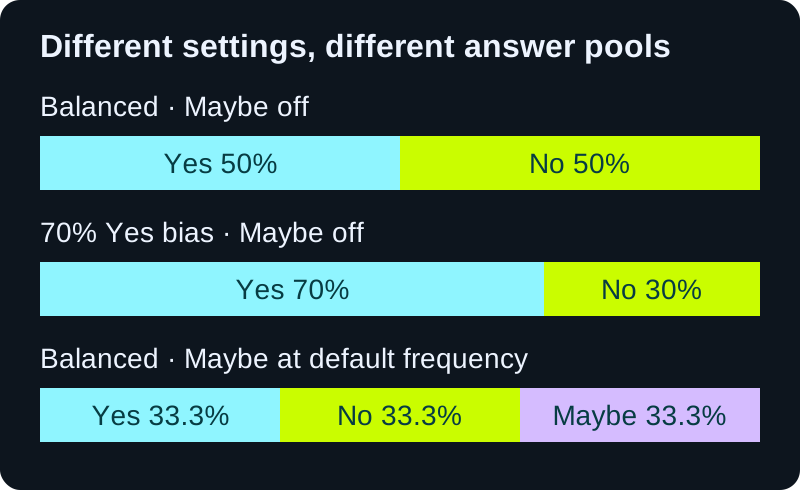
| Settings | Yes | No | Maybe |
|---|---|---|---|
| Balanced; Maybe off | 50% | 50% | — |
| Yes bias 70%; Maybe off | 70% | 30% | — |
| Balanced; Maybe at default frequency | 33.3% | 33.3% | 33.3% |
| Yes bias 70%; Maybe at default frequency | 46.7% | 20% | 33.3% |
Use Possible answers to check the final percentages before drawing. The displayed percentages are rounded. Increasing Maybe frequency gives Maybe more of the pool and reduces the other answers’ shares.
Custom answers replace the standard pool
With at least two custom answers, the tool uses those labels with equal chances and disables the Yes/No bias and Maybe controls. Three custom answers each have a one-in-three chance. Clear the custom answers to return to the standard Yes/No/Maybe settings.
A percentage is a chance on each draw
70% does not promise exactly seven Yes answers in every ten draws. Repeated answers are possible. The percentage beside the selected result describes its chance in the active answer pool; it is not a measure of whether the answer is right for your question. Your question labels the draw without changing its odds.
To compare a fixed sequence with repeats in a longer series, read the coin-flip probability guide. Its calculations assume fair 50/50 flips; the same numbers do not apply to a biased Yes/No pool.
Yes or no generator questions
Is the yes or no result 50/50?
At Balanced with Maybe off and no custom answers, Yes and No have equal odds on each draw. Moving the bias slider changes their relative chances. Consecutive equal answers are still possible.
How does adding Maybe affect the odds?
Maybe adds a third weighted answer. Its weight is compared with the Yes and No weights, so the yes/no percentages no longer describe shares of the entire three-answer pool. Use Maybe frequency to make it appear more or less often. Possible answers shows the resulting percentages.
Do custom answers use the bias slider?
No. When you add at least two custom answers, those answers replace the standard pool and receive equal weights. Check Possible answers to confirm what the next draw can return.
Does the question change the answer?
No. The optional text labels the draw and its history. The tool draws from the active options and settings rather than interpreting your question.
How are the answer percentages calculated?
Each answer has a weight. Its chance is its weight divided by the total weight of all eligible answers. With Balanced and Maybe off, Yes and No are each 50%. With Maybe added at its default frequency, all three are about 33.3%.