Coin flips & probability
Coin Flip Streak Probability: Five Heads vs a Run Anywhere
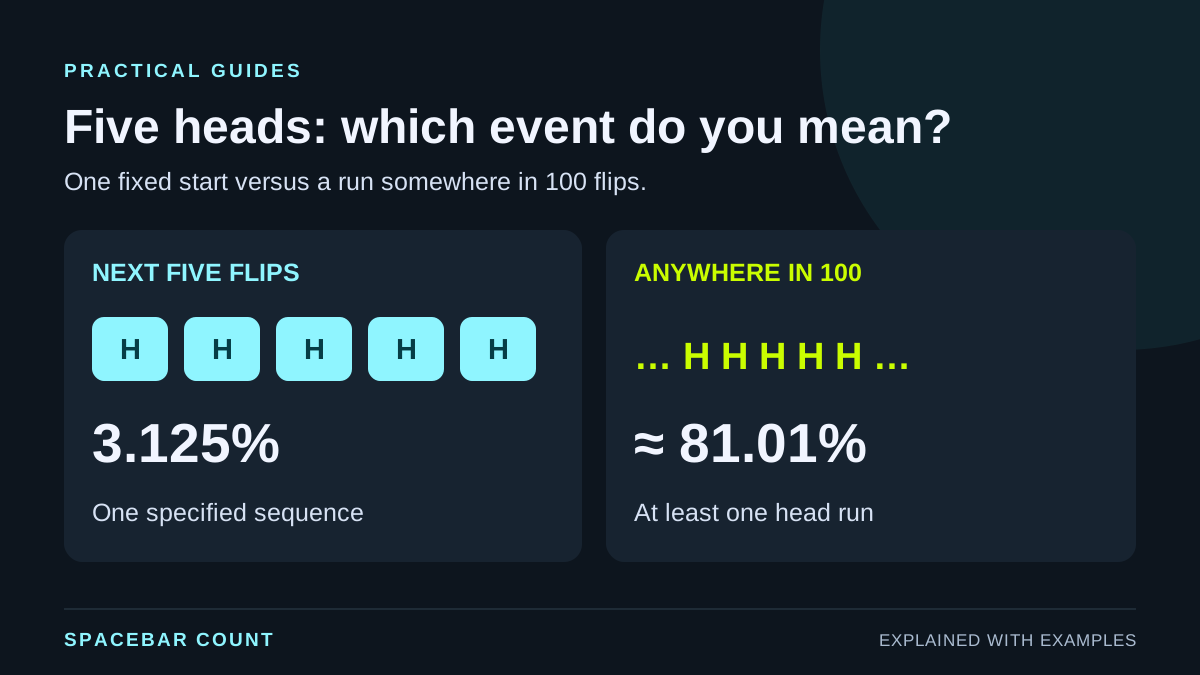
“Five heads in a row” can describe different events. Five specified flips being heads is not the same as finding a five-head run somewhere in a hundred flips.
Four similar questions with different answers
For independent fair flips: the next five being heads has probability 1/32 = 3.125%. At least one run of five heads somewhere in 100 flips has probability approximately 81.01%. The second event has many possible starting positions.
| Question | Probability | What counts |
|---|---|---|
| Next 5 flips are all heads | 3.125% | One specified sequence: HHHHH |
| Next 5 flips are all the same side | 6.25% | HHHHH or TTTTT |
| A run of 5 heads somewhere in 100 flips | About 81.01% | Any starting position; overlaps handled |
| Exactly 5 heads in 10 flips | 24.609375% | Five heads in any positions, five tails elsewhere |
A fair flip has equal chances of heads and tails. Independent means earlier results do not change the chance on the next flip. Every calculation on this page uses both assumptions. It does not estimate the behavior of a physical coin or infer how a particular generator was built.
Change the flip count and compare the events
Compare four coin-flip probabilities
Choose the total number of flips and a run/head count. The first two events concern the next k flips; the last two concern the full n-flip series.
One exact sequence: 1 / 2^5.
All heads OR all tails; two different sequences.
The run may start at different positions. Overlapping runs count as one event.
Any order; all other flips must be tails.
One qualifying start: 5 heads, shown up to 12
H = heads. Every calculation assumes independent flips with a 50% chance of heads. The illustrated sequence is not a prediction.
Example: n = 100 and k = 5. Compare the event descriptions before comparing percentages.
The calculator accepts 1–200 flips and a count from 1 to 30, no
larger than the total. Very small percentages use scientific
notation instead of being rounded to zero. For example,
1e-6% means one millionth of one percent.
These are calculated probabilities. The row of H tokens illustrates one qualifying sequence; it is not a live draw, a prediction or a statement that your next flips will match it.
Why the next five heads has a 1-in-32 chance
For five specified independent fair flips, multiply five factors of one half:
P(HHHHH) = (1/2)^5 = 1/32 = 3.125%
The general expression for k specified heads is
2^−k. The next ten being heads therefore has
probability 1/1024, about 0.09765625%.
If the question allows either all heads or all tails, those are
two different sequences. For k of at least one, add their equal
probabilities: 2 × 2^−k. For five matching sides,
the result is 1/16 = 6.25%.
Do not apply the “either side” multiplier to the already-calculated probability of a run anywhere without checking overlap. A long series can contain both a head run and a tail run, so those events are not disjoint.
Why a run anywhere needs overlapping starts handled
In a hundred flips, a five-head run can begin at position 1, 2, 3 and so on through 96. But those 96 events overlap. The sequence HHHHHH contains a five-head run starting in two positions, while it should count only once toward “at least one run.”
Adding 96 × 1/32 gives 300%, which cannot be a
probability. Even when a simple sum is below 100%,
double-counting overlaps still makes that shortcut wrong.
The calculator tracks the number of consecutive heads at the end of each unfinished sequence: zero through k−1. A tail resets that count to zero; a head extends it. Reaching k records success once. Repeating that update for n flips counts the chance of encountering at least one qualifying run.
A small check is k = 3 within n = 4. The qualifying sequences are HHHT, THHH and HHHH: three of sixteen equally likely sequences, or 18.75%. HHHH qualifies once, even though it has two overlapping starts.
Exactly five heads is a count, not a streak
Exactly five heads in ten flips allows heads in any five of the
ten positions. There are C(10,5) = 252 ways to
choose those positions, and 2^10 = 1,024 possible
ordered sequences overall. The probability is
252/1024 = 24.609375%.
The fair-coin formula is
P(exactly k heads in n flips) = C(n,k) / 2^n. It
counts combinations of head positions. It does not require
adjacent heads, and a six-head sequence fails the “exactly five”
condition even if it contains a five-head streak.
Write whether you mean exactly, at least, or a consecutive run before choosing a formula. Those words define the event rather than merely changing how the same answer is displayed.
Does a head streak make tails due?
After five heads, the next independent fair flip still has a 50% chance of tails. The earlier flips are already observed. Asking for five future heads is different from asking for one more head after four have already occurred.
For example, before any of five flips, HHHHH has probability 1/32. After observing HHHH, only the fifth flip remains uncertain, so the chance of completing that particular run is 1/2. The time at which you ask the question changes what is still unknown.
A short, unbalanced sample is also compatible with equal per-flip chances. Ten flips do not have to produce five of each side.
Try flips without confusing counts and theory
Use the coin flip tool for individual flips and the session’s Heads/Tails counters. Decide how many flips you intend to observe before starting. The tool does not calculate the theoretical probability of a run or provide a full streak-analysis history.
If you want to examine runs, record the order of outcomes as well as the totals. A tally of five heads and five tails does not reveal whether the heads were consecutive. For the broader difference between repeats and unique selection, read why random results can repeat.