Random draws
Why Do Random Numbers Repeat? Unique Draws Explained
A repeated number does not, by itself, mean a random generator is broken. The important question is whether each number stays eligible after it has been picked.
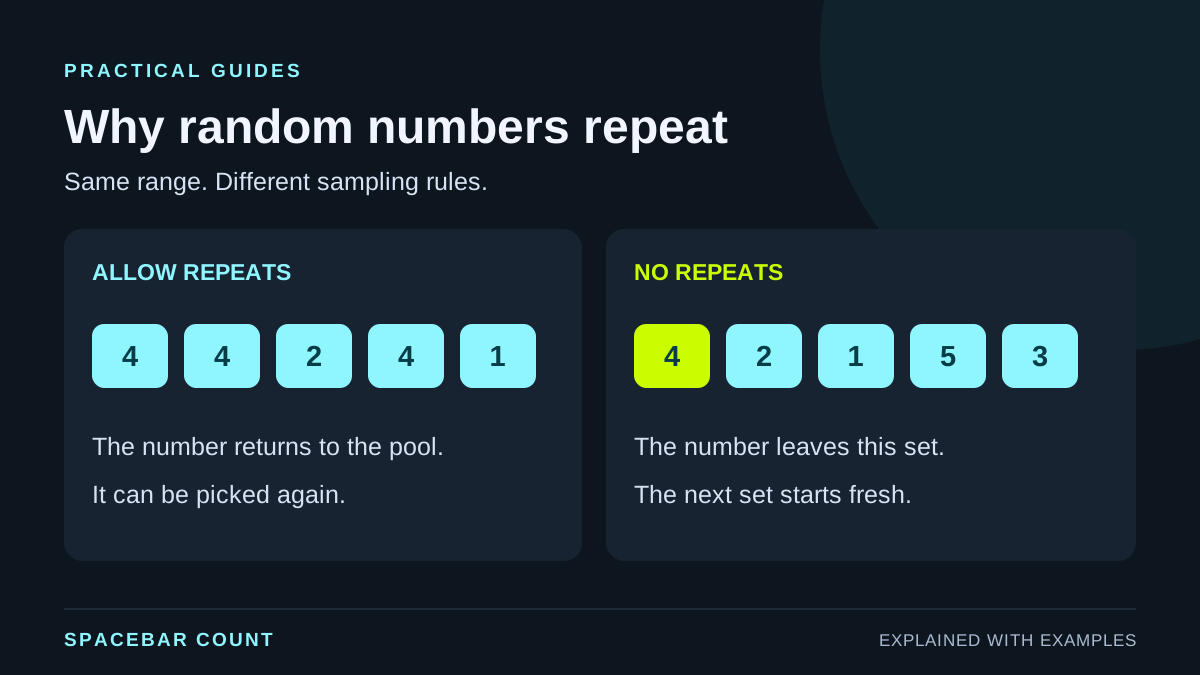
Why can a random number appear twice?
Random does not mean different every time. When a draw allows repeats, every number in the range can appear again. Turn on No repeats when you need different numbers within one generated set.
Imagine drawing a numbered ticket, reading it, and putting it back before the next draw. You could pick that ticket again immediately. Removing it instead changes the next draw: that number is no longer available in the current round.
Both methods are useful. Independent draws suit repeated game events. Drawing without replacement suits choosing different question numbers or assigning distinct positions. Decide which task you need before interpreting a repeated result.
With replacement versus without replacement
Watch the two pools diverge
Step through two illustrated sequences drawn from numbers 1–5. The sequences are fixed so you can compare the rules.
Example after three draws. Continue, or reset to follow the round from the beginning.
| Rule | Can a number repeat? | What happens on the next draw? |
|---|---|---|
| With replacement | Yes, including immediately. | The full range stays eligible. |
| Without replacement | Not within this set. | The selected number is removed from the remaining pool. |
For independent, equally likely draws from 1–10, a particular number has a 1-in-10 chance on each draw. If you remove a selected ticket, there are nine tickets left and each remaining ticket has a 1-in-9 chance next. The possible outcomes have changed.
Generate different numbers in one set
- Open the random number generator.
- Set Minimum to 1 and Maximum to 10.
- Set Quantity to 5 and turn on No repeats.
- Click Generate. You get five different whole numbers within that range.
- Use Copy if you want to keep the set.
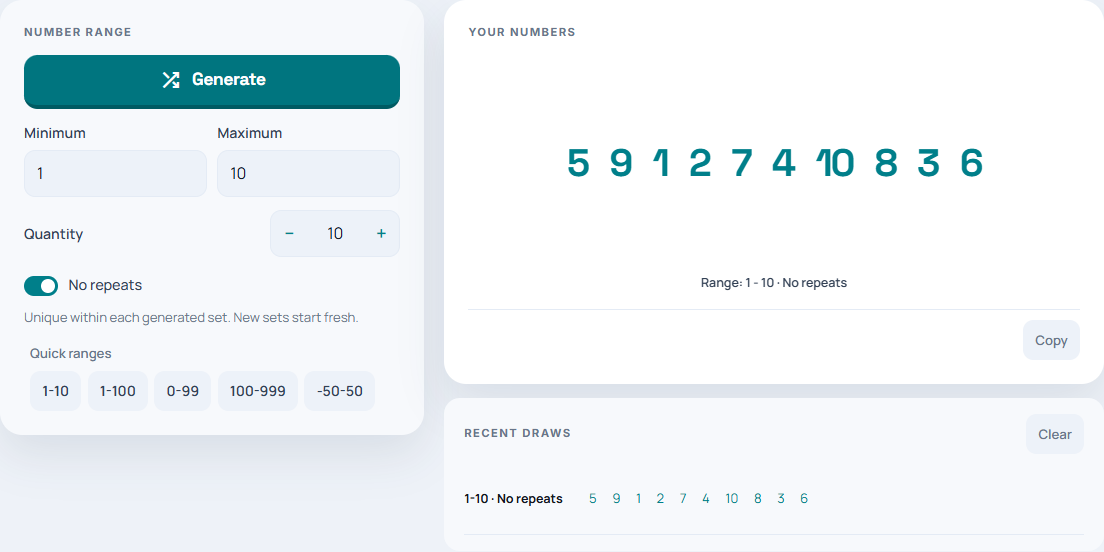
Clicking Generate again starts a fresh set. The next set can share numbers with the previous one. Recent draws records earlier sets; it does not remove those numbers from future sets.
For a round that continues across several clicks, paste your eligible entries into the choice picker and use Pick each item once before repeating. For a full random ordering of named items, use the list randomizer.
Why the range must contain enough numbers
The inclusive range 1–10 contains ten integers:
10 − 1 + 1 = 10. You cannot choose eleven different
integers from it. The same calculation works across zero: −2
through 2 contains five numbers.
If the generator says there are too few different numbers, reduce Quantity, widen the range, or turn off No repeats if duplicates are acceptable. This tool generates up to ten numbers per set.
A five-number set with repeats can contain several copies of the same value. A five-number set without repeats contains exactly five distinct values. Neither mode promises that a short sequence will look evenly spread out.
Repeats can be more common than they look
For five independent, equally likely draws from 1–10, the chance
that all five differ is
1 × 9/10 × 8/10 × 7/10 × 6/10 = 30.24%. The chance
of at least one repeated number is therefore
69.76%.
That calculation describes this specific setup, not a quality test for every generator. A short run of repeats or a tidy-looking sequence cannot prove how a generator was implemented. Choose the sampling rule that fits your task, and evaluate randomness separately if your application requires it.