Games & probability
Can You Win Rock Paper Scissors Against a Random Computer?
A strategy can exploit a predictable opponent. Against independent, equally likely choices, every move still faces one winning reply, one losing reply and one tie.
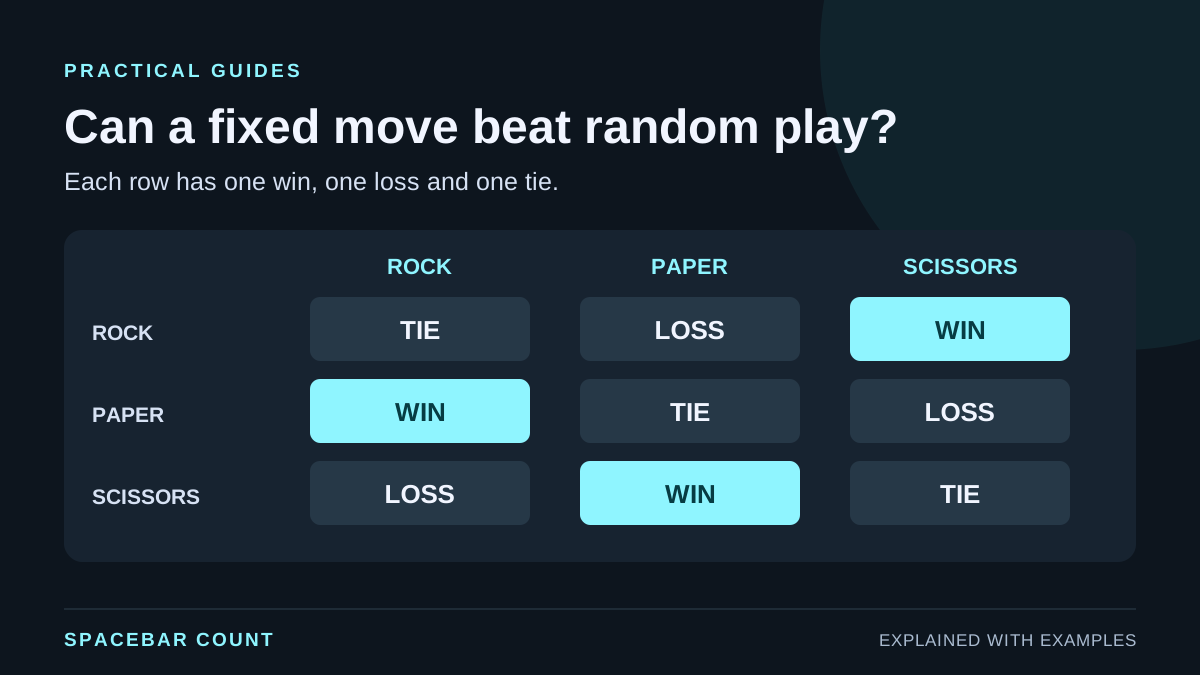
The rules and the answer to “can I always win?”
No move guarantees a win against a fair random opponent. Rock beats Scissors, Scissors beats Paper, and Paper beats Rock. Choosing the same move is a tie.
If the computer independently chooses each move with probability one third, your chosen move wins against one of its possible replies, loses against one and ties against one. Picking a move because it won last round does not change the next round’s chances under that rule.
This does not mean strategy is useless in every game. A person or program can have a predictable pattern. The important distinction is the opponent’s decision rule, not whether your last few rounds happened to go well.
Compare a random opponent with an obvious pattern
Explore the outcome matrix
Choose your move, then compare equal random replies with an illustrated opponent that always plays Rock.
Your move: Rock · Opponent: equal random choices
| You ↓ / Opponent → | Rock | Paper | Scissors |
|---|---|---|---|
| Rock | Tie | Loss | Win |
| Paper | Win | Tie | Loss |
| Scissors | Loss | Win | Tie |
One of three equally likely replies.
One of three equally likely replies.
One of three equally likely replies.
This is a probability model, not your game score. The predictable example is separate from the game’s Adaptive and Momentum breaker modes.
Against equal random replies: one third win, one third loss and one third tie, whichever move you choose.
With equal random replies, the selected row contains three equally likely cells. Switch from Rock to Paper or Scissors: the locations of the outcomes change, but their counts remain one each.
The “Always Rock” example deliberately changes the opponent’s rule. Paper now wins every round because the opponent has become fully predictable. That example is not the same as the site’s Adaptive or Momentum breaker game mode.
All nine cells are equally likely only when both players independently randomize uniformly. When you fix your own move, use its row and the opponent’s probabilities rather than assuming you will visit every cell.
Why win rate can mean 33% or 50%
| Statistic against a fair random opponent | Long-run probability | Denominator |
|---|---|---|
| Wins among all rounds | 1/3 ≈ 33.33% | Wins + losses + ties |
| Losses among all rounds | 1/3 ≈ 33.33% | Wins + losses + ties |
| Ties among all rounds | 1/3 ≈ 33.33% | Wins + losses + ties |
| Wins among decided rounds | 1/2 = 50% | Wins + losses only |
For an example tally of ten wins, ten losses and ten ties, wins are 10/30 of all rounds, or one third. Excluding ties gives 10/20, or one half. Both describe the same tally, using different denominators.
State which rate you mean when comparing scores. The theoretical proportions describe a probability model; a short session need not match them exactly. Three losses in a row do not, by themselves, show that the game is unfair or that the next round must be a win.
What a useful strategy actually needs
A repeated pattern can create an opportunity. If an opponent always repeats the previous winning move, a counter-strategy can target that behavior. But a guess based on two rounds is weak evidence, and a pattern may disappear once the opponent notices your response.
Start by recording the sequence and the conditions under which you think a behavior occurs. Keep wins, losses and ties. Check whether the pattern persists on later rounds rather than selecting only the part of the session that fits your idea.
Balanced, independent random choices remove a simple fixed-move advantage. Human players may still show habits, but there is no universal opening move that guarantees success against every person. A computer can also follow rules that are different from the human opponent you have in mind.
Use Fair mode as the baseline in this game
- Open rock paper scissors and select Fair.
- Choose Rock, Paper or Scissors and read both choices after the round.
- Compare outcomes across a session rather than judging the rule from one result.
- Use Reset when you deliberately want to start a new score comparison.
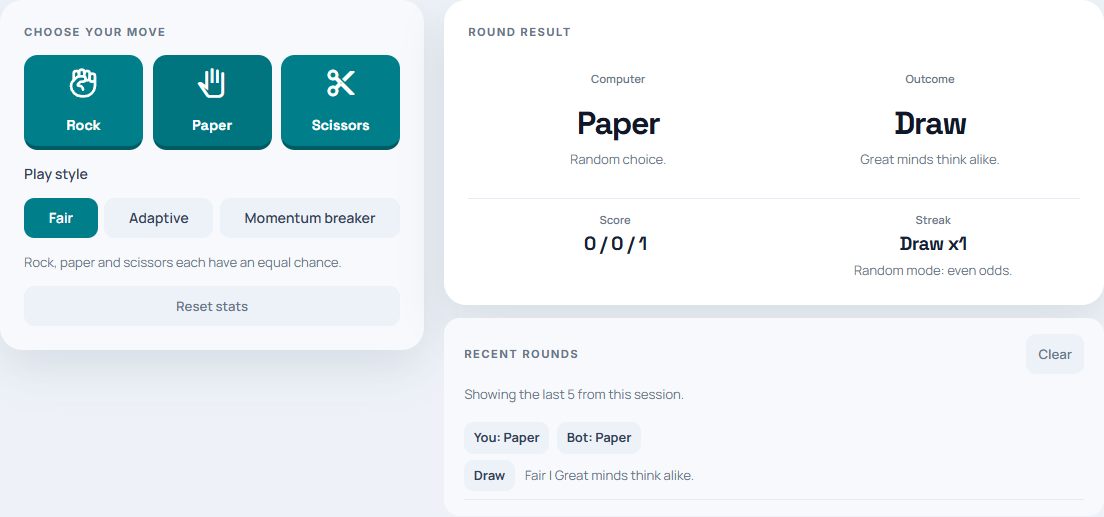
Adaptive and Momentum breaker are different game styles with different response rules. Their scores should not be interpreted as trials against the same independent random opponent. Switching styles midway also changes what a combined score describes.
Use the simplest random choice for the decision
If the purpose is only to decide who takes the first turn, agree on the rule before starting. A single game can tie, so specify whether ties are replayed. For a two-person decision that should finish after one result, a coin flip may be simpler.
If you choose a best-of-three match, agree whether that means first to two wins and how ties are handled. Do not change the stopping rule because the current score is inconvenient.
For the difference between the chance of one result and the chance of a longer sequence, see the coin-flip probability guide. Define the event and its denominator before comparing percentages.